
Search Colleges, Exams, Schools & more


Login
How to Succeed at IGNOU: Study Plan, Time Commitment, Student Support
With over 3.5 million enrollments since IGNOU's inception across its 370 programmes, IGNOU is truly a people’s university. Studying at IGNOU gives you the flexibility to learn at your own pace while balancing work and personal commitments.
This Story also Contains
- How Much Time Should You Study?
- Level-Wise Study Plans
- IGNOU Convocation at a Glance
- Student Support at IGNOU

Without a proper weekly and daily plan, it is easy to fall behind on assignments or feel unprepared for the exam. A simple daily and weekly study routine can make all the difference.
How Much Time Should You Study?
Working professionals, fresh graduates, homemakers, and learners in remote areas all take up IGNOU due to its flexibility. As the mode of study is flexible, consistent effort and discipline are extremely important.
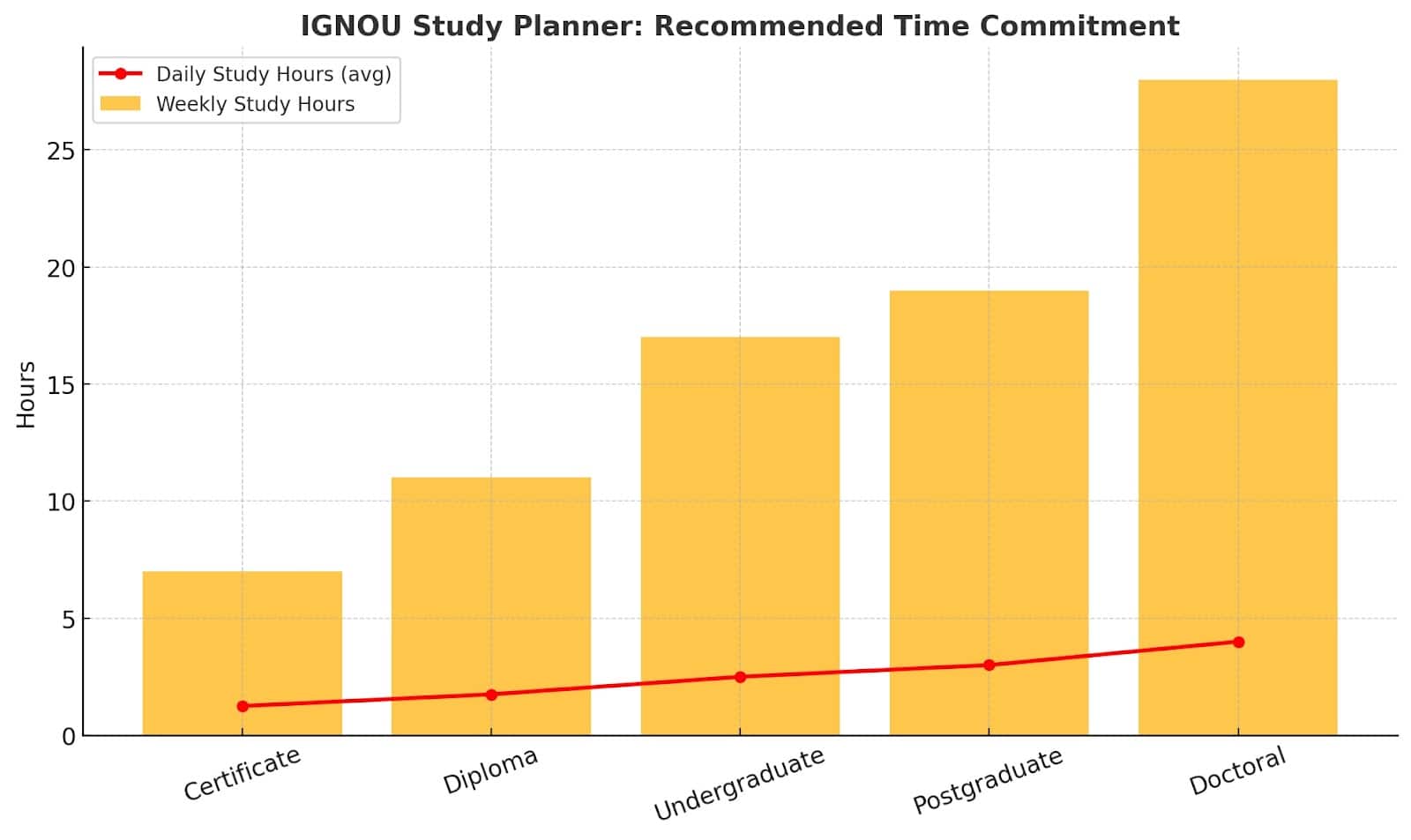
The table below shows the ideal daily and weekly study hours for different programme levels, helping students balance coursework, assignments, and research while staying on track.
| Programme Level | Weekly Study Hours | Daily Study Hours | Focus Areas |
|---|---|---|---|
Certificate | 6–8 Hours | 1–1.5 Hours | Basic Concepts, Quick Skills, Assignments |
Diploma | 10–12 Hours | 1.5–2 Hours | Applied Learning, Fieldwork, Assignments |
Undergraduate | 15–18 Hours | 2–3 Hours | Theory + Practicals, Labs, Assignments |
Postgraduate | 18–20 Hours | 2–4 Hours | Advanced Study, Research, Dissertation |
Doctoral | 25–30 Hours | 3–5 Hours | Research, Thesis Writing, Data Collection |
Success at IGNOU is built on discipline and steady learning. By following the suggested daily and weekly hours, students can easily manage their studies. This ensures stress-free academic progress.
Level-Wise Study Plans
Whether it is a certificate, diploma, an undergraduate degree, a master’s programme, or a doctoral course, your daily and weekly study hours schedule will play a big role in the eventual outcome. Study plans for each level, which will help you balance theory, assignments and real-world applications while making full use of IGNOU’s unique resources.
Certificate Students: Master the Basics
Certificate courses are best for quick upskilling. IGNOU issued 1,61,150 certificates in the last year alone.
Daily (1–1.5 Hours): Spend 30 minutes reading and going through your Self Learning Material (SLM), 20 minutes watching IGNOU e-Content or SWAYAM videos, and around 20 minutes drafting notes or assignments.
Weekly (6–8 Hours): Revise twice a week and solve one set of past TEE questions over the weekend.
Student Tip: Use your commute time to listen to GyanVani FM or podcasts. Even as little as 15 minutes daily listening to FM and Podcasts will add up substantially to the overall understanding and learning of the subject.
Diploma Students: Apply What You Learn
Diplomas go deeper and often include practical work. IGNOU awarded 52,559 diplomas last year in areas like Dairy Technology, Watershed Management, and Creative Writing.
Daily (1.5–2 Hours): 45 minutes to theory, 30 minutes to online lectures, and 30 minutes to assignments or practical logs.
Weekly (10–12 Hours): Set aside one day just for applied tasks, fieldwork, case studies, or lab practice.
Student Tip: Join or start a WhatsApp/Telegram group with batchmates. Peer discussions keep you motivated and accountable.
Undergraduate Students: Balance Theory and Practicals
UG programmes are the largest at IGNOU, with 1,13,876 degrees awarded in 2022–23. With CBCS (Choice-Based Credit System), you can personalise your learning.
Daily (2–3 hrs): 1 hour reading, 30 min for video/audio lectures (GyanDarshan TV or YouTube), 45 min writing TMAs (assignments), and 30 min self-testing.
Weekly (15–18 hrs): Keep your weekends for labs, practical work, or group revision.
Student Tip: Do not wait until the last week for assignments. Write 1–2 questions every week, due to which the workload at the end becomes much easier to manage.
Postgraduate Students: Dive Deep
At PG level, in-depth knowledge matters. IGNOU awarded 1,08,911 master’s degrees last year, covaering programmes from MBA to MA in Journalism, Sustainability, and more.
Daily (2–4 Hours): 1.5 hours reading advanced material, 1 hour analysing research papers, and 30–60 minutes writing assignments or dissertations.
Weekly (18–20 Hours): Dedicate one day to seminar participation, online group discussions, or connecting with mentors.
Student Tip: Use the IGNOU e-Content app to read journal articles and references on the go. Turn idle time into study time.
Doctoral Students: Research with Discipline
If you are pursuing a Ph.D. or M.Phil., your focus should be quality research. IGNOU currently has 762 active Ph.D. students across 23 disciplines, with 359 theses already submitted to Shodhganga.
Daily (3–5 Hours): 2 hours literature review, 1 hour thesis writing, and 30–60 minutes on data analysis or methodology.
Weekly (25–30 Hours): Reserve weekends for writing research papers and supervisor discussions.
Student Tip: Join IGNOU’s Innovation Club or attend webinars. Sharing your research ideas early sharpens them faster.
At IGNOU, consistency is the key, no matter the study level. By utilising your daily and weekly study hours, you can easily manage your assignments, revision, and practical work. Steps like listening to lectures during travel or writing a few assignment answers weekly can make a big difference in the longer run.
IGNOU Convocation at a Glance
IGNOU’s convocation showcased the achievements of its student community, with nearly 2.92 lakh students being awarded degrees, diplomas, and certificates. From doctoral scholars to certificate achievers, the event showcased academic achievements, including 33 gold medallists and strong participation with over 60,000 graduates registered for the ceremony.
| Category | Details |
|---|---|
Total Students Awarded | 2,91,588 students completed degree/diploma/certificate requirements |
Awardees by Level | Masters: 10,8911 Bachelor: 1,13,876 Diploma: 52,559 Certificate: 16,150 |
Other Degrees Conferred | Ph.D.: 75 M.Phil.: 17 |
Gold Medalists | 33 students (Toppers in Minimum Duration Programs) |
Graduates Registered | 60K+ students registered for the 35th convocation |
Student Support at IGNOU
At IGNOU, distance learning doesn’t mean learning alone. The university has established one of India’s strongest student support systems, providing guidance, resources, and opportunities for interaction for every learner.
Regional & Learner Centres
69 Regional Centres (including Army, Navy, Assam Rifles, and Leh) and 2,062 Learner Support Centres provide counselling, assignment help, and exam guidance. Over 51,000 academic counsellors support students.
MOOCs & Online Learning
IGNOU offers 193 SWAYAM MOOCs with 13.5 lakh+ learners, 126 courses adopted by universities for credit transfer. Many courses are available in eight regional languages.
TV, Radio & Web
GyanDarshan TV, SWAYAM PRABHA channels, and GyanVani FM broadcast 13 hours of daily lectures and counselling. Interactive Radio Counselling and Gyandhara internet radio enable direct faculty interaction.
Web Academic Support (WEAS)
The c portal supports 45 programmes with e-content, counselling, and updates. Students also access materials through the IGNOU e-Content App and eGyankosh repository.
Grievance & Counselling
The Student Service Centre resolved 4.28 lakh grievances and 58 lakh queries in 2022–23. Regional Centres held 1,073 induction sessions for new learners.
Support for Marginalised Learners
IGNOU operates Special Centres for Persons with Disabilities, enrolling over 4,200 students with disabilities. Accessible resources include 6.77 lakh e-books via Sugamaya Pustakalaya.
Studying at IGNOU is about building consistent habits. Whether you are planning to pursue a certificate for upskilling yourself or a Doctorate to gain more knowledge, consistency and discipline is the key. Plan your week, stick to your daily hours, and use IGNOU’s resources smartly.
Remember, you chose IGNOU for flexibility. With the right routine, that flexibility helps you complete the programme.
Articles
Upcoming University Exams

List of Related colleges
Questions related to IGNOU
On Question asked by student community
Have a question related to IGNOU ?
Indeed, you can enrol in an IGNOU 1-year diploma program after finishing your 10+2 and then go on to a 3-year LLB program. But here's what you need to remember:
IGNOU Diploma: After your 12th grade year, you can enrol in a variety of 1-year diploma programs offered by IGNOU,
IGNOU theory paper Passing marks for Master programme is 40%. It is 35% for Bachelor programme and you marks are below that so your marksheet show incomplete . If you are having less marks than above limit then you have to re-appear in exam or also you can reevaluate your
Hey there! I'm really sorry to hear you're having such a tough time with your IGNOU admission. That must be so stressful, especially after waiting for over two months without any update. I totally get why you're losing sleep over this - I'd be really worried too if I were
Hello Unnati!!
In order to figure out whether you can obtain a refund of the amounts paid as fees to IGNOU in July 2024, as well as how much you might receive, you should follow these steps:
- Check the IGNOU Refund Policy: IGNOU has a refund policy, which mentions under
Hello,
Yes, IGNOU (Indira Gandhi National Open University) has introduced 4-year undergraduate (UG) degree programs in line with the National Education Policy (NEP) 2020 guidelines .
The NEP 2020 encourages flexibility in undergraduate programs, allowing students to opt for a 4-year UG degree with Honours or Research components. IGNOU has

Applications for Admissions are open.
Among top 100 Universities Globally in the Times Higher Education (THE) Interdisciplinary Science Rankings 2026
Bharati Vidyapeeth University B.Sc Admissions 2026
ApplyNAAC A++ Grade | All professional programmes approved by respective Statutory Council
Shoolini University Admissions 2026
ApplyNAAC A+ Grade | Ranked 503 Globally (QS World University Rankings 2026)
Chandigarh University Admissions 2026
ApplyNAAC A+ Accredited | Among top 2% Universities Globally (QS World University Rankings 2026)
Manav Rachna | B.Sc Admissions 2026
ApplyNAAC A++ Grade | Recognized as Category-1 Deemed to be University by UGC
Chanakya University B.A Admissions 2026
ApplyScholarships available | Collaboration with Samkalp IAS, Delhi